


Bedside Table for a Hydraulic Storage Bed: Fit Guide

A bedside table for a hydraulic storage bed has a job a normal nightstand does not: it must stay useful when the mattress platform lifts, and it must not sit in the way of the person who lifts it. In a compact Delhi or NCR bedroom the table, the storage lid and the wardrobe door often compete for the same strip of floor. If the table is too deep, the lid clips it. If it is too wide, you lose the only walkway beside the bed.
This guide is about placing the table next to a lift-up storage bed, not about choosing a height or a width in isolation.
Who this is for
Use this if you already have, or you are about to buy, a hydraulic or lift-up wooden bed and you need a bedside table that will still work after the platform goes up. It is written for Indian bedrooms, including 1 BHK rooms in Shahdara, East Delhi, Noida and Ghaziabad, where only one side of the bed is truly free.
Measure the bed’s outer width, the height of the mattress, the side from which you lift, and the clear floor beside that rail.
Leave room for the lift, then for the table
A hydraulic bed is opened from the foot or from a long side, depending on the mechanism. Stand where you will stand to lift, raise your arms, and see what your elbows would hit. That zone should stay empty. The bedside table belongs on the sleeping side you use, outside that lift path, and far enough from the rail that the lid does not scrape the top or the lamp.
Depth is the measurement that usually fails. A table 14 to 16 inches deep often leaves a safer gap than an 18 inch chest that looks modest in a showroom. Width can be modest too. In a tight room, a 14 to 16 inch wide table holds a bottle of water, a phone and a small lamp. A 18 to 20 inch top is nicer if the aisle is honest. For a width comparison in ordinary bedrooms, see our guide to a wide vs narrow bedside table.
Keep the table top about level with the top of the mattress, so you can reach a glass without sitting up fully. If you need help matching height to the bed, our note on an 18 vs 20 inch bedside table covers that part of the decision.

One table is often enough beside a lift-up bed
Two matching tables look complete in a catalogue, but a hydraulic bed already asks for clear floor. In many Delhi 1 BHKs, one shallow table on the open side is the right call, and the wall side of the bed stays bare so the platform can rise. If both sides are free and the room is closer to 11 by 12 feet, a second slim table can work, provided neither one sits in the lift path.
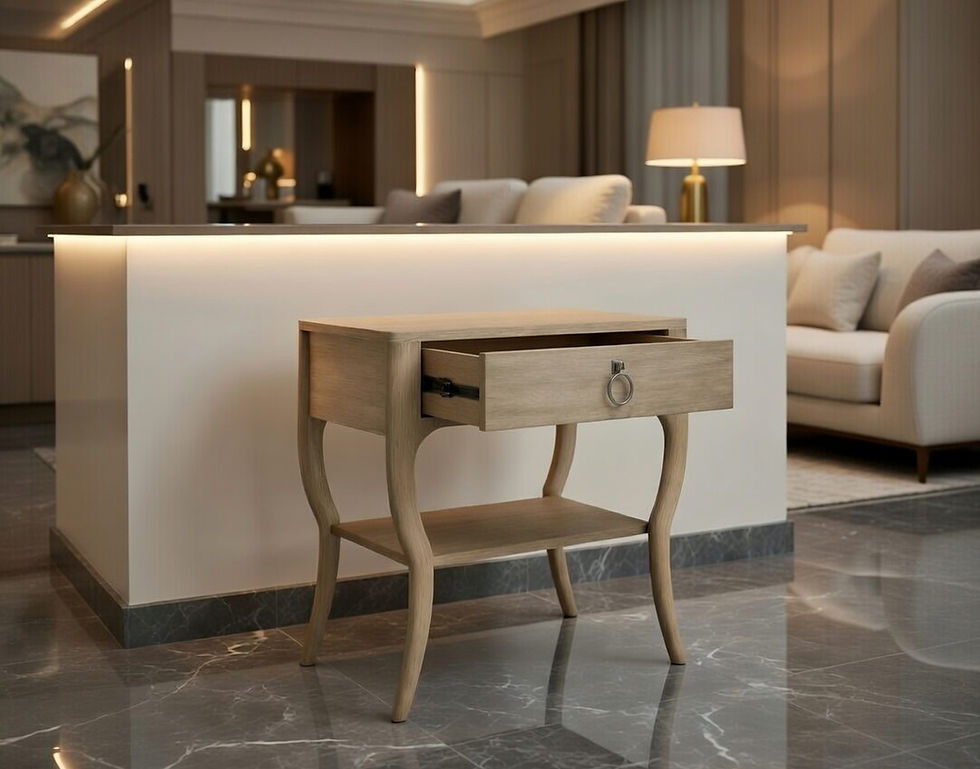
Drawers in the table should open toward you, not into the lid’s arc. A single drawer plus an open shelf is often more practical than a tall three-drawer chest, which can feel like a second wardrobe in a small room and can block the person lifting the bed. Closed storage still helps in India, because Delhi dust settles quickly on an open shelf of medicines and chargers.
A solid wood table with a sealed finish wipes clean and stands steadily on tile. Check that the back is finished if it will be seen when the bed is pulled slightly off the wall for the lift.
Cables, lamps and a lift lid
Run the lamp cable so it cannot catch when the platform rises. A socket in the bedside table is useful only if the lead is long enough for the bed to open. Do not perch a tall vase or a heavy speaker on the table edge nearest the lid. A low lamp with a firm base is safer than a shade that leans into the lift.

How to measure beside a hydraulic bed
With the bed in place, or with its outline taped on the floor, mark the lift side and the sleeping side. Measure the clear width between the bed rail and the wall, the wardrobe or the window AC. Then mark the table top and the drawer opening. Open the imaginary lid and walk around it. If you have to move the table to lift the bed, the table is too deep or it is in the wrong place.
If you have not yet bought the bed, take both measurements to the showroom: the room, and the way you plan to stand when the storage opens.
What to check before you buy
Confirm which side the hydraulic lid opens from, and keep that path clear.
Measure table depth and width against the aisle, not only against the mattress height.
Check that drawers open away from the lid and that a lamp will not catch.
Decide whether one table is enough before you buy a matching pair.
Ask which wood and finish are used, and how to wipe daily dust.
Compare the exact product dimensions with the tape marks on your floor.

Visit the Shastri Park showroom
You can stand a solid wood bedside table next to a storage bed in our showroom at Gate No. 4, Shastri Park, Shahdara, Delhi 110053, open 10 AM to 8 PM all seven days. Bring your room and bed measurements, or call and WhatsApp +91-7838834141 before you visit.
All products are currently 30% off, with free pan-India delivery. Returns are accepted for any reason within 7 days of delivery, including customised items, with free return shipping and a prepaid label in the package. Refunds are issued in 7 days; exchanges are not offered. Damage in transit is covered across India.
Frequently asked questions
Can I use a bedside table for a hydraulic storage bed on both sides?
Only if both aisles stay clear when the lid is up and you can still walk to the wardrobe. In most compact Delhi bedrooms, one table is the safer choice.
How deep should the table be next to a lift-up bed?
A depth of about 14 to 16 inches is a practical starting point in a tight room. Go deeper only if you have marked the lift path and the drawer opening on the floor.
Will a chest of drawers work as a bedside table here?
Usually not, unless the room is generous. A deep chest sits in the lift path and steals the walkway.
What should I keep on the table so the lid can open safely?
A short lamp, a glass and a phone. Keep tall or heavy objects away from the edge nearest the bed.
Can I compare bedside tables next to a storage bed in Delhi?
Yes. Visit Gate No. 4, Shastri Park, Shahdara, or WhatsApp +91-7838834141 with your bed’s outer size and lift direction.

Comments